Heading into 2026: Rate Cuts, Property Prices & New Policies
Pina Brandi • August 13, 2025

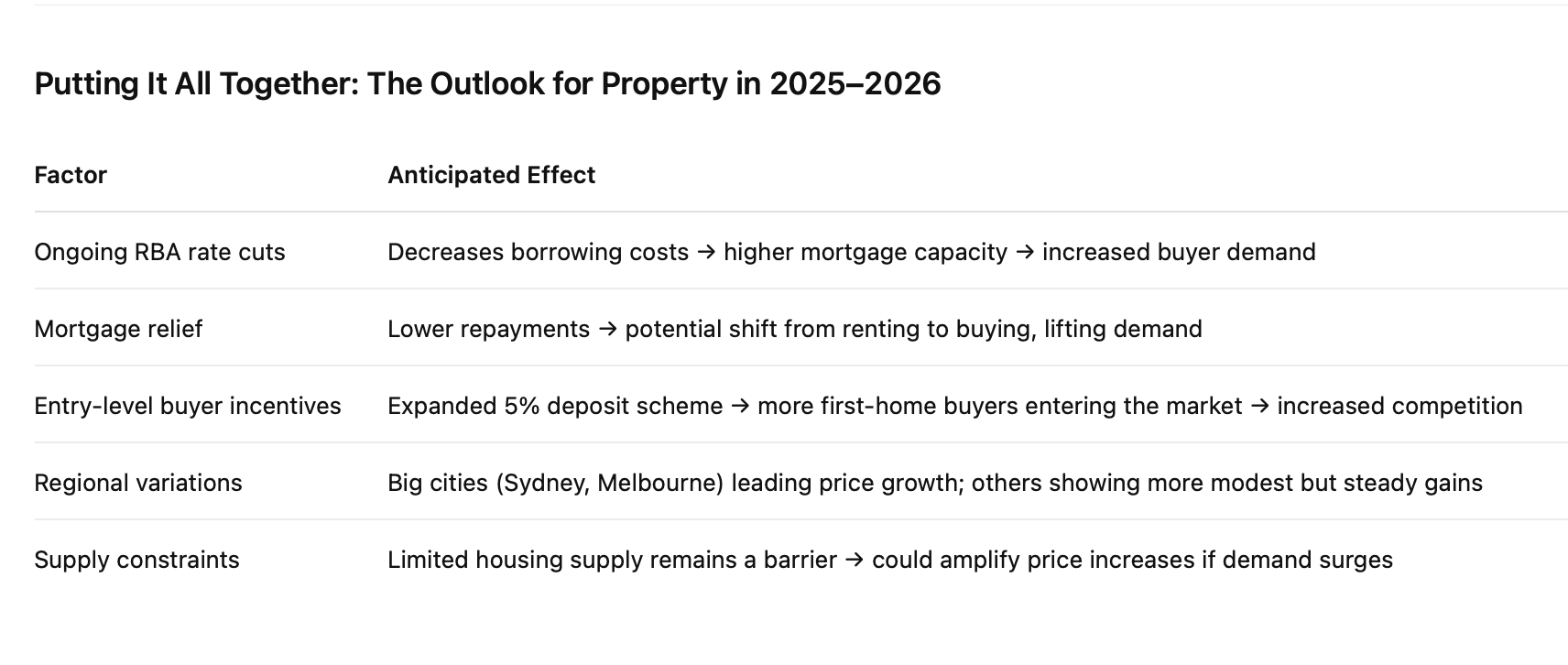
On 12 August 2025, the Reserve Bank of Australia (RBA) made a move that’s already sending ripples through the housing market — another 25 basis point cut to the cash rate, bringing it down to 3.60%. This marks the third cut this year, with the RBA pointing to cooling inflation (headline at 2.1%, underlying at 2.7%) and a softer labour market as key reasons for easing monetary policy.


The good news for borrowers came quickly. All four of Australia’s big banks — CBA, NAB, Westpac, and ANZ — wasted no time in passing on the cut to variable home loan customers. For many households, this means hundreds of dollars in monthly savings. On a $500,000 mortgage, the reduction could save around $272 a month, or over $3,300 a year. For those with a $700,000 loan, the annual savings are closer to $1,100. That’s money that can make a real difference to household budgets, and it could also play a big role in shaping property demand.

Lower interest rates have always had a habit of stirring up the housing market. When borrowing becomes cheaper, more buyers can step in, and many can stretch their budgets further. Analysts are already predicting a lift in prices. Some forecasts suggest a 6–10% increase nationally by early 2026, while others, like Domain’s Tulip model, point to gains of up to 12% — which could add a staggering $141,000 to median capital city prices if cuts continue into next year.


Sydney and Melbourne are tipped to lead the charge. KPMG expects Sydney prices to rise 3.3% in 2025 and then accelerate to 7.8% in 2026. Melbourne could see similar momentum, with 3.5% growth this year and 6% next. By June 2026, the median Sydney house price could hit $1.83 million, while Melbourne’s could push past $1.1 million. Even now, Sydney values are already up 6.5% for the year, and loan sizes are creeping higher, with the national average now around $678,000.

As if cheaper borrowing wasn’t enough to heat things up, January 2026 is set to bring another wave of market-changing policies. The government will expand the 5% Deposit Guarantee Scheme to all first-home buyers, regardless of income, and raise the property price caps. Buyers using the scheme won’t need to pay Lenders Mortgage Insurance (LMI), which can save tens of thousands of dollars. This is a massive boost for first-home buyers, and it’s likely to draw even more competition into an already tightening market.


There’s also a two-year ban on foreign buyers purchasing established property, which remains in place until at least 2027. While this may reduce some competition at the high end, the effect at the entry level could be the opposite — more local buyers fighting for the same limited stock. With supply still struggling to keep up with demand, the combination of rate cuts and policy changes could create a perfect storm for price growth.


So, what does this mean for you? If you’re a homebuyer, you may find that while the cost of borrowing falls, the race to secure a property gets tougher. The months ahead could see open homes buzzing with more buyers, auctions heating up, and prices edging higher. For sellers and investors, however, the landscape is looking promising. The mix of cheaper finance, expanded buyer incentives, and persistent supply constraints is setting the stage for potentially significant gains in property values.


Whether you’re buying, selling, or just watching from the sidelines, one thing is clear — the next 18 months in Australian real estate are going to be anything but dull.


This is why you need someone in your corner to help you navigate the crazy times ahead.

Book a complementary call and lets have a chat and see how we can assist you.


share to

By Pina Brandi December 10, 2025
Around 2017–2018, growth stalls and dips modestly after APRA’s investor growth cap (2014) and interest‑only cap (2017), which is the effect you’re asking about.
By Pina Brandi December 1, 2025
Melrose Park’s transformation from an industrial precinct into a residential and mixed-use community has been a strategically significant shift for Sydney’s urban future. Historically, the area was home to pharmaceutical and light-industrial operations, but over time these industries declined, consolidated elsewhere, or simply outgrew the outdated warehouses and fragmented road layout. Keeping the land zoned industrial would have meant under-utilising a large, strategically located pocket of Sydney at a time when housing demand is at critical levels. Redeveloping Melrose Park allows Sydney to introduce thousands of new homes in an inner-suburban area without pushing growth further to the city’s outskirts. With capacity for around 10,000–11,000 dwellings, plus retail, open space, a new high school and community facilities, the precinct is envisioned as a self-contained, modern neighbourhood with liveability at its core. Instead of being an isolated residential pocket, Melrose Park is being planned as a walkable, amenity-rich town centre where green spaces, urban parks, and mixed-use buildings form a cohesive and sustainable environment. Its location is one of its strongest advantages. Positioned on the Parramatta River, the suburb sits almost exactly halfway between Sydney CBD and Parramatta CBD, making it highly attractive for commuters who want balance, convenience and lifestyle. It is minutes from major employment hubs, established transport corridors like Victoria Road, and future connections that will further integrate the precinct into Sydney’s broader network. The land parcel is also unusually large and contiguous for an inner-suburban area, enabling a full masterplan rather than piecemeal development.  Overall, the shift from industrial to residential in Melrose Park wasn’t just a rezoning exercise; it was a strategic realignment of land use to meet Sydney’s changing economic, demographic, and lifestyle needs. Its prime location ensures the precinct will continue to attract demand, support growth, and deliver long-term value for residents and investors alike.
By Pina Brandi November 29, 2025
APRA has been explicit that the DTI cap is a financial‑stability tool, but it is deliberately designed not to choke off finance for new housing supply
Show More